Yes, you read that correctly! Quantitative data made me cry this week. Okay, maybe not cry cry, but it certainly caused some exaggerated sighs and complaining to my husband.
This week we are discussing quantitative research articles. I will be the first to admit that this topic is less than fascinating for me. There are three sets of numbers I am comfortable with. Numbers with dollar signs in front of them, numbers followed by cups, tablespoons, or teaspoons, and grades. Anything other than that, and I have completely lost interest. Here’s the deal, when you are working on a Doctorate of Education sometimes you have to work with things that scare you. This week, I created a presentation where I analyzed three different quantitative articles and attempted to present some of the numerical data in a manner that is easier to understand for those of us not interested in numbers.

Lets get started, shall we?
Perceived Changes in Leadership Behavior during Formal Leadership Education by Sorensen et al (2023) examines how three different groups of people (superiors, subordinates, and peers) perceive changes in leaders who participating in a leadership development program. The behaviors being studied task-oriented behavior, relations-oriented behavior, and change-oriented behavior. This was the most difficult article for me to analyze since it used terms like multi-level regression and exploratory factor analysis. There was a lot of numerical data and numbers and letters that did not make much sense. The gist of the article is leaders were perceived to have the most growth from year one to year two. The leaders stayed at roughly the same level from year two to year three.
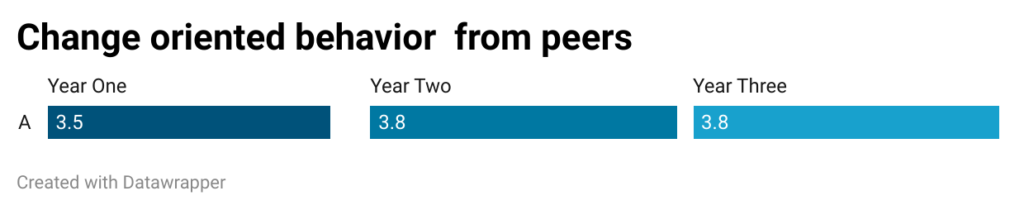
As you can see in the graphic above, there is a perceived increase from year one to year two based on the responses from the leader’s peers.
Narratives for Wise Thinking in Leadership: An Experiment on the Influence of Wise Leader Exemplars’ Narratives on Wise Thinking in Leadership by Bostanli (2023) examines how leadership narratives of wise leaders impact the thinking of other leaders. The study found reflecting on the leadership narratives of wise leaders does impact leaders and helps them to understand their own knowledge and skill limits.
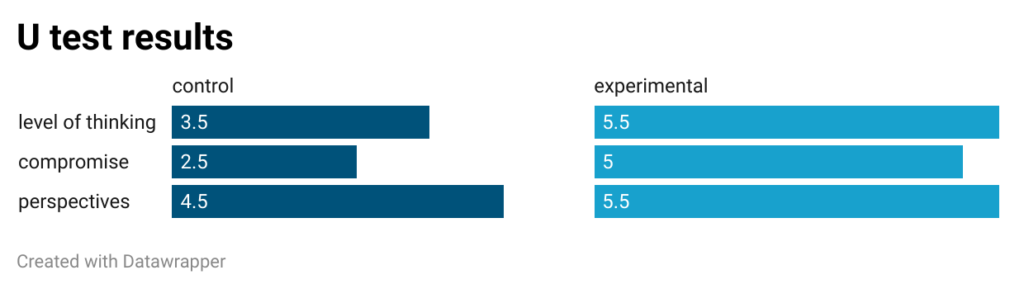
These numbers show the difference between the control group and the experimental group on recognizing their own limits.
Being Explicit about Virtues: Analyzing TED Talks and Integrating Scholarship to Advance Virtues-Based Leadership Development by Newstead (2022) is the article that intrigued me the most (and it was not because it was the shortest article! There were one or two articles shorter than this one). I think since this article was more word based than numbers based it held my attention a little longer than the other articles. Newstead analyzed 25 different TED talks to see how often virtues like wisdom or helpfulness came up in talks about leadership. What he discovered is virtues are not a dominating theme in leadership development. The virtues mentioned the most were helpfulness and love. Leadership was technically mentioned the most but since the TED Talks were about leadership and leadership skill development it was a given it would be mentioned more often than others.
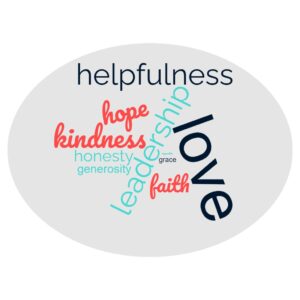
This image made the most sense to me since I could see how often the virtues were mentioned based on the size of the word.
What Does This Mean For My Future?
Now comes the question of what does this even mean for those of us who probably have dyscalculia and have never taken statistics? I discovered between Google and supportive cohort members; the big scary numbers and Greek symbols can be broken down into something that makes a little bit of sense. If all else fails, read the discussion portion of the article and see if you can make the numbers make sense!
References
Bostanli, L. (2023). Narratives for wise thinking in leadership: An experiment on the influence of wise leader exemplars’ narratives on wise thinking in leadership. Psychology of Leaders and Leadership, 26(2), 115–126. https://doi.org/10.1037/mgr0000141.supp (Supplemental). https://search.ebscohost.com/login.aspx?direct=true&AuthType=sso&db=psyh&AN=2023-71413-001&authtype=sso&custid=s9008876&site=ehost-live&scope=site&custid=s9008876&authtype=sso.
Newstead, T. (2022). Being explicit about virtues: Analysing TED talks and integrating scholarship to advance virtues-based leadership development. Journal of Business Ethics, 181(2), 335–353. https://doi.org/10.1007/s10551-021-04966-2. https://search.ebscohost.com/login.aspx?direct=true&AuthType=sso&db=bth&AN=160780251&site=ehost-live&scope=site&custid=s9008876&authtype=sso.
Sørensen, P., Hansen, M. B., & Villadsen, A. R. (2023). Perceived changes in leadership behavior during formal leadership education. Public Personnel Management, 52(2), 170–190. https://doi.org/10.1177/00910260221136085. https://search.ebscohost.com/login.aspx?direct=true&AuthType=sso&db=ccm&AN=163764889&authtype=sso&custid=s9008876&site=ehost-live&scope=site&custid=s9008876&authtype=sso.